Blog
Commercial Pest Control Phoenix | Alpha Pest Control

If you’re a business owner searching for commercial pest control in Phoenix, something has likely already gone wrong — or you’re smart enough to make sure it doesn’t. Perhaps a customer spotted a cockroach near the hostess stand. Or maybe a health inspector flagged rodent droppings in the storage room. Even a single incident like this can trigger a failed inspection, a damaging online review, or a temporary closure that costs your business thousands.
Phoenix’s year-round warm climate means pests never take a season off, and commercial properties face higher stakes than homes. A homeowner dealing with ants is annoyed. A restaurant owner dealing with ants risks their health score, their reputation, and their livelihood. This guide covers what Phoenix business owners need to know about commercial pest control — which pests target which types of businesses, what Maricopa County inspectors actually look for, why reactive treatment fails, and how to build a pest management plan that keeps your doors open and your reputation intact.
Why Commercial Pest Control in Phoenix Is Different From Residential
Residential pest control and commercial pest control share some of the same pests, but the similarities end there. Commercial properties face a completely different set of challenges.
Regulatory compliance. Restaurants, food service operations, healthcare facilities, and food processing businesses in Maricopa County must meet specific health and safety standards enforced through routine inspections. Consequently, a pest sighting during an inspection can result in violations, fines, mandatory re-inspections, or temporary closure. The Maricopa County Environmental Services Division conducts these inspections, and pest activity is one of the most common violation triggers.
Reputation exposure. In the age of online reviews and social media, one photo of a cockroach in a dining area or a rat near a dumpster can spread instantly. As a result, the reputational damage from a single pest incident can far exceed the cost of ongoing prevention.
Larger and more complex facilities. Commercial buildings have more entry points, larger kitchens, shared walls between tenants, loading docks, dumpster areas, and HVAC systems that create pest pathways residential homes don’t have. Therefore, treatment plans need to be customized to the specific layout and operations of each business.
After-hours service requirements. Most commercial pest treatments need to happen outside business hours — typically overnight or early morning for restaurants, and weekends for offices. This requires a provider with scheduling flexibility that not all companies offer.
Documentation and record-keeping. Health inspectors may ask to see pest control service logs during routine inspections. Your provider should deliver detailed records of every visit, including treatment areas, products used, pest activity findings, and recommendations. Without these records, you’re vulnerable during inspections even if your facility is clean.
The Pests That Target Phoenix Businesses
Different types of businesses attract different pests. Understanding which pests pose the highest risk to your specific operation is the first step in building effective commercial pest control in Phoenix.
Restaurants and Food Service
Restaurants are the highest-risk commercial environment for pest infestations because they combine everything pests need: food, water, warmth, and shelter.
Cockroaches are the most critical threat. German cockroaches in particular thrive in commercial kitchens — they reproduce rapidly (a single female can produce 300+ offspring in her lifetime), hide in equipment motors, behind dishwashers, inside wall voids, and under prep stations. A single cockroach sighting during a health inspection can trigger an immediate violation. In addition, cockroach allergens can contaminate food and surfaces, creating health risks for staff and customers.
Rodents (primarily roof rats and house mice) target restaurants through loading docks, utility penetrations, and gaps around exterior doors. They contaminate food storage areas, chew through packaging, and leave droppings that fail inspections instantly. Dumpster areas that aren’t properly maintained are a major attractant.
Flies (drain flies, fruit flies, house flies) are common in kitchens with grease traps, floor drains, and produce storage. While less alarming than cockroaches or rodents, fly activity during a health inspection still results in violations.
Stored product pests — including Indian meal moths, flour beetles, and grain weevils — infest dry storage areas and can contaminate entire inventories of flour, rice, spices, and other staples.
Offices and Corporate Spaces
Office buildings face different pest pressures than food service, but the problems are no less disruptive.
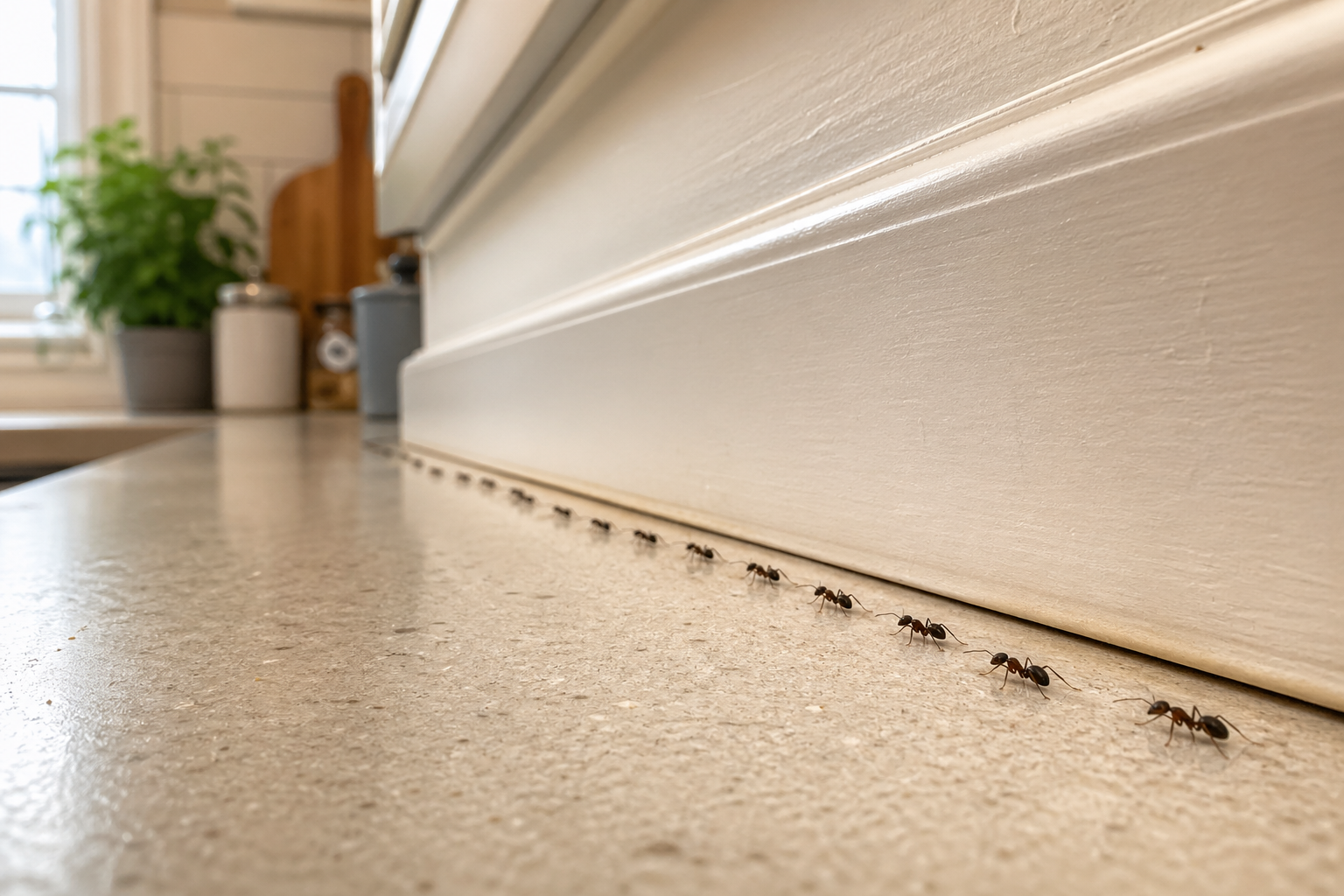
Ants are the most common office pest in Phoenix. Break rooms, kitchenettes, and vending areas attract foraging ants — particularly odorous house ants and Argentine ants. Once a trail is established, ants show up daily until the colony is addressed.
Scorpions are a significant concern for ground-floor offices in newer developments built on former desert land. Bark scorpion stings in the workplace create liability issues and employee safety concerns.
Spiders (especially black widows) nest in storage rooms, server closets, parking garages, and ground-level utility areas. An employee encounter with a venomous spider creates both a health risk and a morale problem.
Retail and Hospitality
Bed bugs are a primary concern for hotels, resorts, and short-term rental properties. Phoenix’s tourism and convention traffic means a constant flow of guests who may introduce bed bugs from previous stays. A single confirmed bed bug report can result in room shutdowns, refund demands, and devastating online reviews. For more on the challenge of eliminating them, our guide on how to get rid of bed bugs in Phoenix covers the treatment process in detail.
Rodents and pigeons are persistent problems for retail strip centers, shopping plazas, and mixed-use developments. Pigeons roost on signage, eaves, and loading areas, leaving acidic droppings that damage surfaces and create health hazards for employees and shoppers.
Warehouses and Industrial
Rodents are the top threat in warehouse environments. They damage inventory, chew through wiring (creating fire hazards), contaminate palletized goods, and nest in insulation and stored materials.
Termites target warehouse structures with wood framing, and infestations can go undetected for months in large facilities with limited interior inspection access.
Birds — particularly pigeons and sparrows — enter through open dock doors and nest in rafters, contaminating products below with droppings.
What Maricopa County Health Inspectors Look For
For restaurants and food service businesses, understanding what inspectors actually check for helps you stay ahead of problems. While inspection standards cover a broad range of food safety issues, pest-related items that commonly trigger violations include evidence of rodent activity (droppings, gnaw marks, nesting material), live or dead cockroaches in food preparation or storage areas, fly activity in the kitchen or dining area, pest entry points that haven’t been addressed (gaps under doors, unsealed utility penetrations, damaged screens), and absence of pest control service documentation.
Inspectors don’t just look at whether you have a pest control provider — they look at whether your facility is actively maintained to prevent pest entry and whether you can document regular professional service. For this reason, having a provider that delivers detailed service reports after every visit is essential.
The Arizona Department of Agriculture’s Office of Pest Management oversees licensing and compliance for pest control providers statewide. Make sure your commercial provider is properly licensed through this office.
Why Reactive Pest Control Fails for Businesses
Many Phoenix business owners treat pest control as a problem to solve rather than a system to maintain. They call a pest company when someone sees a cockroach, get a one-time treatment, and assume the problem is handled. However, this reactive approach fails for commercial properties for several important reasons.
Pests are already established before you see them. By the time a cockroach appears in the dining room, there are likely hundreds hidden in wall voids and equipment. By the time you see rodent droppings, the rodents have been active for days or weeks. One-time treatments address symptoms, not the underlying infestation.
Compliance requires documentation of ongoing service. A one-time treatment three months ago doesn’t satisfy a health inspector asking to see your pest control logs. Regular, documented service demonstrates proactive management.
Arizona’s climate means year-round pressure. Unlike seasonal markets where pest pressure drops in winter, Phoenix businesses face active pest populations every month. As a result, quarterly or “as needed” service leaves gaps that pests exploit.
Commercial environments are constantly changing. New deliveries, staff turnover, seasonal menu changes, facility modifications, and neighboring tenant activity all create new pest opportunities. Consequently, a static treatment plan quickly becomes outdated.
What Effective Commercial Pest Control in Phoenix Looks Like
A professional commercial pest management program should include several key components that work together.
Integrated Pest Management (IPM)
IPM is the industry standard for commercial pest control, and it’s what health inspectors expect to see. Rather than relying solely on chemical treatments, IPM combines prevention, monitoring, and targeted intervention. According to the EPA, IPM focuses on long-term prevention through a combination of techniques including biological control, habitat modification, and use of resistant varieties, with pesticides applied only as needed.
In practice, this means your pest control provider should be inspecting and identifying conditions that attract pests (not just spraying on a schedule), recommending sanitation and structural improvements, using monitoring tools (sticky traps, bait stations, inspection logs) to track activity trends, applying targeted treatments based on what monitoring reveals, and documenting everything for your records.
Customized Service Schedules
Every business has different needs. A high-volume restaurant kitchen may require weekly or bi-weekly service. An office building may need monthly visits. A warehouse may benefit from monthly perimeter treatment with quarterly interior inspections. Your provider should recommend a schedule based on your specific pest pressure, not a one-size-fits-all package.
After-Hours Flexibility
Treatments should happen when your business is closed. For restaurants, that typically means late night or early morning service. For offices, evenings or weekends work best. Your provider should accommodate your operating schedule without requiring you to shut down during business hours.
Detailed Reporting
After every service visit, you should receive a report documenting what was inspected, what pest activity was found, what treatments were applied, and what recommendations were made. These reports serve double duty — they keep you informed about conditions on your property and they satisfy inspector requests for documentation.
How to Choose the Right Commercial Pest Control Provider in Phoenix
Not all pest control companies handle commercial work effectively. When evaluating providers for commercial pest control in Phoenix, look for several key qualifications.
Licensing and insurance. Verify that the company holds a current Arizona pest management business license through the Arizona Department of Agriculture and carries commercial liability insurance. This is non-negotiable for any business engaging a pest control provider.
Commercial experience. Ask specifically about experience with your type of business. Restaurant pest control requires different expertise than warehouse or office work. A company that primarily serves residential customers may not understand the compliance requirements, documentation standards, or treatment protocols your business needs.
IPM approach. Your provider should describe their approach in terms of prevention, monitoring, and targeted treatment — not just “we spray monthly.” If the entire pitch is about chemicals, that’s a red flag.
Documentation standards. Ask to see a sample service report. It should include specific findings, treatment details, and actionable recommendations — not just a checkmark that says “service completed.”
References from similar businesses. Ask for references from businesses in your industry. A provider who excels at restaurant pest control may have a strong track record that’s easy to verify.
Response time for urgent issues. Ask what happens if you find a rodent on a Tuesday afternoon. Your provider should offer same-day or next-day emergency response for critical issues, not a “we’ll add it to next month’s visit” approach.
How Alpha Pest Control Handles Commercial Pest Control in Phoenix
Alpha Pest Control has been serving commercial clients across the Phoenix Valley since 1987. We understand that your business can’t afford a pest problem — not the health code risk, not the reputation damage, not the lost revenue. Our commercial pest management program is built around prevention, compliance, and fast response.
We serve restaurants, offices, retail spaces, warehouses, medical facilities, and multi-unit properties throughout Tempe, Phoenix, Chandler, Mesa, Scottsdale, Gilbert, Ahwatukee, and Sun Lakes. Our commercial service includes thorough facility inspections covering all pest entry points and risk areas, customized IPM treatment plans tailored to your business type and operating schedule, after-hours service to avoid disrupting your operations, detailed documentation for health inspection compliance, and fast-response service for urgent pest issues between scheduled visits.
Commercial pest control works best alongside comprehensive property maintenance. Many of our commercial clients also benefit from pigeon control, rodent exclusion, and weed management services that keep their entire property clean and compliant. The National Pest Management Association offers additional resources for business owners evaluating pest management programs.
If your business needs reliable, documented pest management, request a free commercial inspection or get a quote. We’ll assess your facility, identify your specific risks, and build a service plan that protects your business, your customers, and your reputation.
Frequently Asked Questions About Commercial Pest Control in Phoenix
How often should a commercial property have pest control service? It depends on the business type. Restaurants and food service operations typically need weekly or bi-weekly service. Offices and retail spaces generally require monthly treatment. Warehouses and industrial properties may benefit from monthly perimeter service with quarterly interior inspections. Your provider should recommend a schedule based on your specific pest pressure and compliance requirements.
Is commercial pest control required by law in Phoenix? There is no Arizona law requiring businesses to have a pest control contract. However, Maricopa County health codes require food service establishments to maintain sanitary conditions and take proactive measures to prevent pest infestations. In practice, this means regular professional pest control with documented service records is essential for restaurants and food-related businesses.
What happens if my restaurant fails a health inspection due to pests? Consequences vary based on severity. Minor pest-related violations may result in point deductions on your inspection score and a required correction timeline. More serious findings — such as active rodent infestations or widespread cockroach activity — can lead to fines, mandatory re-inspections, or temporary closure until the issue is resolved. In all cases, your inspection results become public record.
How much does commercial pest control cost in Phoenix? Costs vary based on facility size, pest pressure, and service frequency. Most small to mid-size commercial clients fall in the $100 to $250 per service range. Larger facilities or properties with specialized needs (food processing, warehousing) may cost more. The best approach is to request a free on-site inspection so the service can be scoped accurately.
What’s the difference between IPM and traditional pest control? Traditional pest control relies primarily on scheduled chemical applications. Integrated Pest Management (IPM) combines prevention, monitoring, and targeted treatment — using chemicals only when monitoring data indicates they’re needed. IPM is the industry standard for commercial properties because it’s more effective long-term, reduces unnecessary chemical use, and satisfies health inspector expectations.
Can I handle commercial pest control myself? For most commercial properties, DIY pest control is not advisable. Certain products are regulated by the EPA with specific guidelines for use in restaurants and retail spaces, and misapplication can violate laws. Additionally, health inspectors expect to see documentation from a licensed professional pest control provider. Self-treatment doesn’t satisfy compliance requirements and often fails to address the full scope of commercial pest challenges.
Do you service restaurants after hours? Yes. Alpha Pest Control offers after-hours service for restaurants and food service businesses. Treatments are scheduled when your kitchen is closed to avoid disrupting food preparation and to allow products to settle before the next business day.